Researcher · Speaker · Advocate

BiaKaoriMi

Brazilian researcher, public speaker, and rare disease advocate working at the intersection of disability rights, inclusive design, population aging, and Japan-Brazil cultural relations. My practice is comparative and cross-disciplinary by design.

Accessibility Population Aging Japan-Brazil Rare Diseases Inclusive Design
Portrait of Bia Kaori Mi

Heritage & Perspective

Brazilian-Japanese Identity

I am a Brazilian of Japanese descent, what in Brazil we call nikkei. Brazil is home to the largest Japanese diaspora outside Japan, with around 2 million people of Japanese origin. Growing up embedded in both cultures was not simply a biographical fact: it became the structural lens through which I read everything I research.

When I study aging in Japan, I am not approaching it as a foreign observer. When I write about accessibility in Brazil, I carry with me a comparative frame built over a lifetime. Being between two cultures is not a gap to be explained away. It is the method.

Bia Kaori Mi as a child

"My experiences as a disabled person and as a Brazilian-Japanese woman have shaped a unique worldview that I share through talks, courses, and publications in multiple languages."

Brazilian flag

Brazil

Born and raised in São Paulo. Academic training at USP. Research on disability law, aging policy, and Japan-Brazil comparative studies.

Japanese flag

Japan

Ancestral roots, primary research context, and linguistic frame. Japanese studied to source level, reading primary materials directly.

United States flag

United States

FD/MAS Alliance advocacy base. Work experience at Brafton Inc. in content marketing and international communications.

2M+

Japanese Brazilians, the largest Japanese diaspora outside Japan. A community I belong to and research within.

Mission statement

"I don't believe in keeping research confined to academia. To create real change, we need to engage every layer of society."

Bia Kaori Mi

The Short Version

How I Got Here

My path into this work was not linear, and I am not sure I would have wanted it to be. I began as an academic researcher at USP, the Universidade de São Paulo, where I joined GEASIA, the Asian Studies group within NUPRI, the research center on international relations. Japan entered my life as a scholarly subject and stayed as something considerably more complicated.

Then came the diagnosis. Living with fibrous dysplasia and McCune-Albright syndrome moved accessibility from a research interest to a daily condition, and it changed what I thought research was for. The questions I had been asking about aging populations and disability infrastructure stopped being abstract.

Today the work runs on three tracks that feed each other: academic research and publication, public advocacy for rare disease patients across Brazil and the United States, and teaching and speaking to audiences who would never read a journal article. None of these would be as good without the other two.

How I Work

Comparative by default. Nothing gets studied in isolation. Japan and Brazil read each other.

Lived experience counts as evidence. Not instead of data. Alongside it.

Research leaves the building. If it stays in a journal, it has not finished its job.

Four languages, one argument. The audience changes. The rigor does not.

Rare Disease Advocacy

Living With, and Speaking For, FD/MAS

I live with fibrous dysplasia and McCune-Albright syndrome, a rare bone and endocrine condition that affects a very small number of people worldwide. Rare means something specific in practice: few specialists, little published research in your language, and almost no one who can tell you what to expect.

In 2023 I became the first Brazilian FD/MAS patient advocate in Latin America, working with the FD/MAS Alliance across Brazil and the United States. The work is unglamorous and necessary: translating clinical material into Portuguese, connecting patients who thought they were alone, and making sure Portuguese speakers are not the last to receive information.

This is also where my research and my life stopped being separate subjects. Accessibility is not an abstraction when you are the person the building was not designed for.

Bia Kaori Mi at an FD/MAS Alliance community event

Research Focus

Pillars of Study

Six areas that keep converging, whatever the starting point.

  • 01

    Population Aging

    Japan as the first super-aged society, and what Brazil can learn.

  • 02

    Accessibility & Disability Policy

    The distance between what a law promises and what a street delivers.

  • 03

    Japan-Brazil Relations

    Diplomatic, economic, and cultural exchange between two countries.

  • 04

    Rare Disease Advocacy

    Patient representation and community for conditions too rare to have one.

  • 05

    Inclusive Design

    What gets built when disabled people are in the room from the start.

  • 06

    Identity & Diaspora

    Knowledge that belonging to two cultures produces and neither generates alone.

Education & Recognition

Academic Foundation

2021

MSc, Japanese Language, Literature and Culture

Universidade de São Paulo (USP), Faculty of Philosophy, Languages and Human Sciences (FFLCH)

Thesis on Japan as the world's first super-aged society: its challenges, population decline, policy responses, and the condition of Japanese women.

Japan East Asia Public Policy Population Aging Demography Geopolitics Sociology Culture Immigration

Affiliation since 2015

GEASIA / NUPRI, USP. Member of the Asian Studies group within the research center on international relations, concentrating on population aging, accessibility, disability policy, and Japan-Brazil relations.

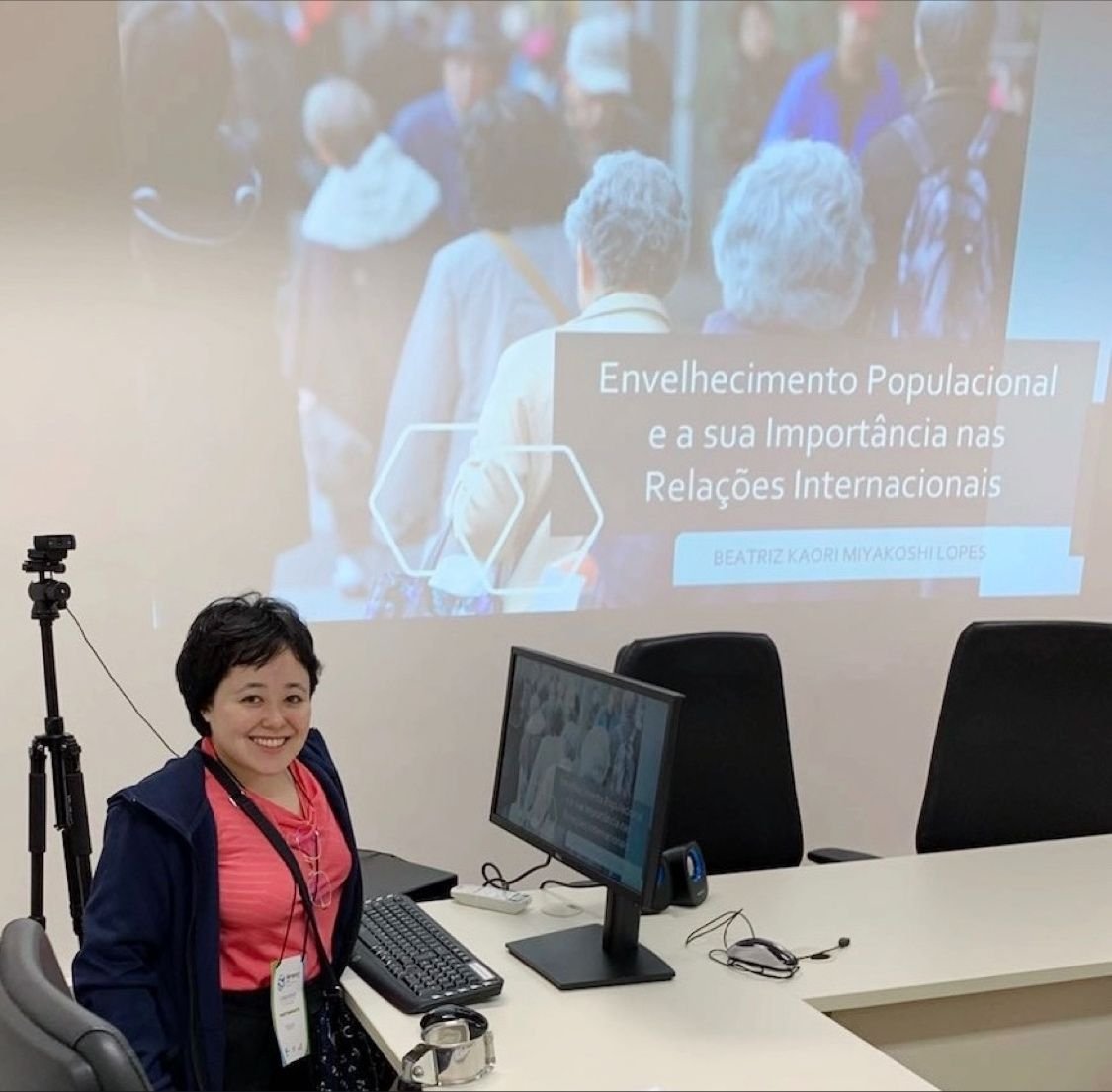
2016

BA, International Relations

Faculdades Integradas Rio Branco (FIRB)

Thesis on population aging and international relations, analyzing the five countries with the highest proportion of elderly residents: Japan, Italy, Spain, Portugal, and Greece.

Geopolitics History Economy International Relations Theory Human Rights International Law

Awards & Honors

  • 2015 & 2016

    Academic Merit Certificates ×2

    One for each of the 5th and 6th semesters, awarded to the top grade average in International Relations.

  • 2016

    Honra ao Mérito, VI RBMUN

    Honorable mention for exemplary participation at the sixth Rio Branco University Negotiations Model.

Languages & Training

Credentials & Qualifications

Brazilian flag

Portuguese

Native

United States flag

English

Fluent. TOEFL iBT 119/120 (2020) · CELTA

French flag

French

Advanced. DALF C2 (2017)

Japanese flag

Japanese

Intermediate. JLPT N2 (2018)

Selected Certificates

  • 2023

    Global Health Policy

    University of Tokyo.

  • 2023

    Principles and Practice of Clinical Research (IPPCR)

    National Institutes of Health (NIH).

  • 2020

    Medical Technology and Evaluation

    University of Minnesota.

  • 2020

    Foundations of Virtual Instruction

    University of California, Irvine.

  • 2020

    Transforming Communities

    University of Colorado Boulder.

  • 2020

    Translation Quality Management

    Tomsk State University and Palex.

And several more across public health, Japanese studies, digital marketing, translation, data analysis, and research methods.

Research & Professional Background

Where the Work Happened

2023 to Present

Patient Advocate, FD/MAS Alliance

First Brazilian FD/MAS patient advocate in Latin America, operating across Brazil and the United States. Community building, translation, and patient representation.

2021 to 2022

Volunteer across 20+ NGOs

Team leader, project manager, teacher, translator, editor, and mentor, expanding access to knowledge across Brazil.

2015 to Present

Researcher, GEASIA / NUPRI, USP

Member of the Asian Studies group within the research center on international relations for over a decade. Comparative work on Japan-Brazil policy, disability infrastructure, and population aging, with contributions to multiple courses.

At a Glance

10+ years in academic research.

4 languages spoken across research and advocacy.

First Brazilian FD/MAS patient advocate in Latin America.

Two countries of active advocacy: Brazil and the United States.

Publications

Published Research

Peer-reviewed articles, a dissertation, and a book chapter, in Portuguese and English.

  • 2022

    Invisible Beings: An Overview of People with Disabilities' Circumstances in Japan

    Revista Estudos Japoneses, Universidade de São Paulo, n. 48. English translation of the 2020 Portuguese original.

    Journal
  • 2021

    COVID-19 no Japão: o que (não) explica a incidência relativamente baixa

    Carta Internacional, ABRI.

    Journal
  • 2021

    Master's Dissertation on Japan as the First Super-Aged Society

    Universidade de São Paulo. Aging, population decline, and the condition of Japanese women.

    Dissertation
  • 2021

    Chapter in the eBook Prezada Cultura

    Contributed chapter.

    Book
  • 2020

    Seres Invisíveis: Um Panorama sobre a Condição de Portadores de Deficiência no Japão

    Revista Estudos Japoneses, Universidade de São Paulo, n. 44. Portuguese original.

    Journal
See all publications on the Media page

Speaking & Public Engagement

On Stage and On Air

I speak in English and Portuguese, to academic audiences and to people who have never read a paper in their lives. The registers are different. The evidence is the same.

  • 2024

    Guest Lecturer, Security, Strategy and Defense: Geopolitics in the Asian Continent

    GEASIA / USP.

  • 2023

    Interview, Rádio Senado

    On Japan and population aging.

  • 2023

    Panelist, Fiocruz Event

    On health, aging, and public policy.

  • 2022

    Panelist, Accessibility Roundtable

    On disability infrastructure in Brazil and Japan.

Bia Kaori Mi presenting at an event

Teaching

Teaching Runs Through Everything

Teaching has never been a side activity. It is where I find out whether an argument actually holds, because a room of students will tell you immediately when it does not.

  • 2021-22

    Teacher and Admissions President, Academia Julia Lopes de Almeida

    Teaching and leading the admissions process for a volunteer-run academy.

    Academy
  • 2021-22

    Volunteer English Teacher, English for Beginners

    Free English instruction for Brazilian students with no access to paid classes.

    Volunteer
  • 2021

    Portuguese Teacher for Refugees, OPIR

    Portuguese as a language of welcome for Haitian refugees and other high-risk migrants.

    Volunteer
  • 2021

    Guest Lecturer and Course Organizer, GEASIA / USP

    Extension courses on Asian geopolitics, aging societies, and Japan-Brazil relations.

    University
  • 2007-09

    Japanese and Manga Art Teacher, Colégio Integrado Global

    Japanese language and manga illustration for school-age students.

    School

Service

Volunteer Work

Between 2021 and 2022 I contributed to more than twenty non-governmental organizations as team leader, project manager, teacher, translator, editor, and mentor.

  • FD/MAS Alliance2023-PresentPatient and family advocate
  • English for Beginners2021-22Volunteer English teacher
  • OPIR, Organização Pelos Imigrantes e Refugiados2021Portuguese teacher for refugees
  • Academia Julia Lopes de Almeida2021-22Teacher and Admissions President

Current Focus

What I'm Working On Now

Active Research

Disability Policy, Brazil and Japan

Continuing comparative analysis of disability legislation, infrastructure, and lived experience, with an emphasis on what actually transfers between legal systems.

Advocacy

FD/MAS Advocacy, Brazil

Ongoing patient advocacy with the FD/MAS Alliance: awareness campaigns, material translation, and community building for Portuguese-speaking patients.

Publication

Academic Writing, In Progress

Preparing new academic contributions on disability studies and aging policy through the GEASIA group at USP.

Teaching & Talks

Available for Events and Lectures

Accepting invitations for academic lectures, corporate talks, and media appearances on accessibility, aging, Japan-Brazil relations, and rare disease. English and Portuguese.

With Gratitude

Acknowledgments

Parents & Japanese Family

For unconditional love and support at every stage of life, always modeling ethics and generosity.

Professors & Advisors

For intellectual richness and guidance throughout the academic journey at USP and beyond.

Friends

For the laughter, lightness, and encouragement through every project and difficult season.

Marketing Team

For creativity and care from the very beginning, before this project even had a name. A special thank you to Ana Paula and Diego.

FD/MAS Community

For connection, shared learning, and the courage to advocate publicly across borders.

Logo Creator

For artwork that captures exactly who I am, with precision and warmth. Designed by Sofia.

Frequently Asked

Questions I Get Asked Most

What languages do you speak and present in?

I present in English and Portuguese with equal comfort. I also read and work in French and Japanese, which matters for source material more than for stage work. If your event needs a bilingual session or simultaneous material in both languages, that is straightforward.

What topics do you speak on?

Population aging and what Japan's experience offers other countries; accessibility and disability policy; Japan-Brazil relations and diaspora identity; and living with a rare disease. Talks can be adapted for academic, corporate, healthcare, or general audiences.

Are you available for interviews and press?

Yes, in both languages, including on short notice for journalists working to deadline. The contact form is the fastest route, and a fuller record of previous coverage is on the Media page.

Do you take research collaborations?

Yes. I am open to comparative work on aging, accessibility, disability policy, and Japan-Brazil relations, particularly projects that bring lived experience into the evidence base rather than treating it as anecdote.

How should organizers reach you?

Use the contact form on this page and select the inquiry type that fits. The speaker kit has the practical detail organizers usually need next: formats, topics, and requirements.

Get in Touch

Let's Start a Conversation

Whether you're a journalist on deadline, an event organizer, a researcher looking to collaborate, or simply curious: fill in the form and I'll get back to you within a few days. I respond in English or Portuguese.

Please enter your name.

Please enter a valid email address.

Please choose an inquiry type.

Please write a message.

Required fields.

Message sent! Thank you for getting in touch. I will get back to you within a few days.